Showing posts with label Karen Simpson. Show all posts

Saturday, March 12, 2011

Meet: Karen Simpson, author of ACT OF GRACE

It is my great pleasure to present published author Karen Simpson! Karen was the first person to comment on my personal blog years ago, and will always hold a special place in my heart for marching into her local Borders and asking where the heck my novel was when she didn't see it in their inventory. Turns out it was right on the shelf and no one in the store would have known that without Karen's intervention. So I am thrilled that I can return the favor and march onto the internet and tell folks go get Act of Grace! Congratulations Karen on the publication of your first novel!

Q&A with Karen:


White Readers Meet Black Authors: Tell us about Act of Grace (read an excerpt here). How did you come to write this story? What subjects/themes do you explore? What's your writing style like?

Karen Simpson: First, I would like to thank you for this opportunity. I always dreamed of appearing as an author on your blog so I’m truly excited to do this interview.

Act of Grace is the story of Grace Johnson a bright, perceptive African American high school senior who saves the life of a Klansman named Jonathan Gilmore. Everyone in her hometown of Vigilant, Michigan wants to know why. Few people, black or white, understand her act of sacrifice especially since rumor holds that years ago a member of the Gilmore family murdered several African -Americans including Grace’s father. Grace wants to remain silent on the matter but Ancestors spirits emerge in visions and insist she fulfill her shamanic duties by bearing witness to her town’s violent racial history so that all involved might transcend it.

Grace begins a journal, but she warns readers upfront that if they are looking for a simple or rational explanation for her actions then they need to look elsewhere. She knows that her accounts of her ability to speak to the dead, along with her connections to a trickster spirit name Oba, will be hard for most people to believe. With insight shaped by the wisdom found in African American mythology and the book, The Velveteen Rabbit, Grace recounts a story of eye-for-an-eye vengeance that has blinded entire generations in her hometown.
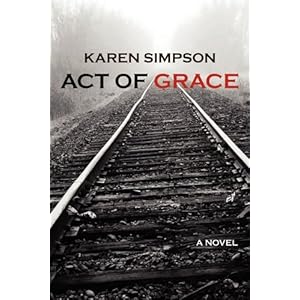
Act of Grace is loosely based on an incident that happened several years ago in my hometown during a Klan rally. When what was supposed to be a nonviolent protest became violent, a young black woman saved a white man, (whose was simply wearing a confederate flag T-shirt), from being beaten by throwing her body over him. She got involved because she believed he had the right to his beliefs even if she and others felt he was wrong. For weeks after the event people argued about whether she was a guardian angel or just crazy. My opinion was that she was a compassionate and brave person, worthy of admiration and respect for living up to her values. Five years after this rally I had a very vivid dream about a young woman named Grace and during the dream she yelled out what is more or less the first line of the novel.

My novel fits in with my lifelong interest in how some people are able to forgive what seem to be unforgivable acts and deeds and the subjects of altruism and justice. Especially justice, because while I believe it is my duty as an artist and writer to illuminating injustice, I also believe it is my duty to acknowledge how complicated and sometime messy getting justice is.

WRMBA: What's your goal(s) as a writer? Do you set out to educate? entertain? illuminate?

KS: I set out to illuminate but in an entertaining way in my work. Act of Grace deals with serious and violent issues, but I tried to make sure there was as much sweet as bitter in the work. Grace is a strong, willful young woman being sent out to do strong women’s work, but she has an incredible sense of humor and knows or learns how to experience joy even in the mist of sorrow.

WRMBA: What's your biggest surprise-good or bad- (so far) about the publishing biz?

KS: How much of a business writing really is. I was warned up front that it was but I was still surprised how much marketing an author is required to do herself. I’m finding that I’m better at it than I thought though.

WRMBA: What's next for you?

KS: A new, so far untitled, work that one writer friend described as a historical novel with paranormal sprinkles.

WRMBA: What's the best book (or whose the best writer) that not enough people know about?


Dr. Flowers has a new graphic novel from Tara Books called I See the Promised Land on the life of Martin Luther King. He does the telling as a griot, while Patua artist Manu Chitrakar adapts King’s life to his art. Patua artists from Bengal in eastern India are traditional scroll-painters who create vivid art out of all kinds of narratives - from fables and classical tales to contemporary news items. It a wonderful book that gives a new and powerful take on Martin Luther King’s life.

WRMBA: Any advice for aspiring novelists?

KS: If you are serious about getting published, work at writing as you would a career or job. Learn the craft by become a part of critiques groups, go to as many conferences as you can afford. Read all kinds of novels and writing book, but, in addition, read books and blogs about how to conduct the business side of writing. A good book to start with is The Essential Guide to Getting Your Book Published by Arielle Eckstut and David Henry Sterry.

Monday, October 4, 2010

Guest review of THIS I ACCOMPLISH

This I Accomplish: Harriet Powers Bible Quilt and Other Pieces by Kyra Hicks is a testament to how quilts can tell stories as rich and complex as any novel. In a passionate voice fueled by comprehensive research, Hicks introduces readers to a fuller and truer version of the life and work of master quilter, Harriet Powers.

Harriet Powers was born a slave in Georgia on October 29, 1837. It is assumed that she was raised as a house slave and learned to sew as a child. She is best known for two magnificent story quilts she made after the Civil War.  For over 125 years the Bible Quilt and the Pictorial Quilt she stitched have been closely studied for what they could tell historians and museum curators about African American folk art and the lives of slaves after the Civil War. Because she was a slave, scholars assumed she was illiterate. This assumption had often been used by scholars to explain the so called primitive look of the appliqué figures she used on her quilts to tell stories from the Bible and her life.

Powers’ life and quilts seemed to be so well known; Hicks originally intended her book to be a simple annotated bibliography. However, as she pored over the sources she began to notice that some researchers, made statements about Mrs. Powers and her quilts without citing verifiable references. Curious, Hicks decided to make a game of challenging what she read, and like the fictional African American woman detectives she admires in her favorite mystery novels, Hicks began to ask new questions about Harriet Powers and her famous quilts. Questions like: Was Powers really illiterate? What was the exact chain of custody or historical background for each quilt? Had Powers created other quilts and where were they if she had?

As if to make sure that everyone understood exactly where she was coming from, Powers triumphantly signed her letter: This I Accomplish, Harriet A. Powers.

It is because Hicks decided to ask what she didn’t know as opposed to accepting as fact what others had written that we readers are now blessed to have the full story of both the Pictorial Quilt and the Bible Quilt. We now know in intricate detail the movements of each quilt from one interesting owner to the next on their journey to their final homes in The National Museum of American History at the Smithsonian Institution in Washington D.C and the Museum of Fine Arts in Boston, Massachusetts. In addition, we also get to experience Hick’s joy and astonishment when her hard work and curiosity pays off in the discovery of an incredible letter written by Powers herself. In the letter, the quilter states not only that she was literate but also how she became so.  She also declares that she was the creator of at least three other quilts and represented her own artwork at fairs and shows. As if to make sure that everyone understood exactly where she was coming from, Powers triumphantly signed her letter: This I Accomplish, Harriet A. Powers.

The story of the discovery of the letter and the stories of the people who owned the quilts would have been enough to make This I Accomplish special, but Hicks goes above and beyond this. In the second half of the book she presents a complete annotated bibliography including books, articles, poems, plays, exhibits and other media. She also presents timelines that help place Powers and her quilts in context with what was going on in the rest of the world. And as if to pass on the baton of her meticulous research, Hicks offers in the concluding pages of her book, questions and ideas for future historians, museum curators, and quilters to work on. Examples of future projects range from: locating other quilts by Powers, to the petitioning the Postal Service to issue a commemorative stamp celebrating the 185th anniversary of her birth in 2012.

I loved this book. The new research it uncovered about Powers and her life made my heart sing and after a long hiatus of just writing fiction, I felt the need to go back to my first love of quilting. I am deeply grateful to both Kyra Hicks and the magnificent quilt artist, Mrs. Harriet Angeline Powers, for reviving my passion of telling stories with fabric.

About the guest reviewer
Karen Simpson in Ann Arbor Michigan. Writing, fabric art and history are her passions. She taught African American quilting for over twenty years before her focus shifted to stitching words together to create fiction. Her debut speculative novel Act of Grace will be published in February 2011 by Plenary Publishing. In the novel Grace Johnson, an African American high school senior saves the life of a Klansman and everyone in her hometown of Vigilant, Michigan wants to know why.  With insight shaped by voices of ancestors and spirits Grace bears witness to her towns violent racial history so the all involved might transcend it. More information can be found on Karen’s blog Grace Notes.