Showing posts with label Lori Tharps. Show all posts
Showing posts with label Lori Tharps. Show all posts
Tuesday, August 31, 2010
And the winner of Substitute Me is...
Sissy, you won the copy of Substitute Me by Lori Tharps! Congratulations! Send me your snail mail addy and I will ship it off to you.


Tuesday, August 24, 2010
Meet: Lori Tharps, author of SUBSTITUTE ME

"Book clubs: Substitute Me one will give you so much to talk, laugh and argue about, you might want to schedule two meetings to discuss it. Days after finishing it, I'm still debating who the villain is. Lori Tharps has written a timely, engaging page-turner that every working mom in America should read!"
Carleen Brice, author of Children of the Waters
Below is my Q&A with Lori, which hopefully gives you more of a taste about what her book is like. If you'd like more of an idea listen to blogger Evelyn N. Alfred read a snippet (and then follow her advice and go to your local bookstore and buy it).
White Readers Meet Black Authors: What's Substitute Me about?

Lori Tharps: This is a story about a young, career-driven woman who is about to go back to work so she hires a full-time nanny for her infant son. The woman happens to be white and the nanny happens to be black. The story takes place in modern-day brooklyn and simply documents the lives of both women and the people in their lives. In essence, the story tries to show what can happen when one woman hires another woman to perform her most intimate tasks -- caring for her child, home and ultimately her husband. Throw in some issues of race and class and you've got a really packed domestic drama.
WRMBA: There was an article in the NY Times recently about nanny fiction (a new genre?). How would you compare your book to The Help or The Nanny Diaries (which I know are two completely different types of books)?
LT: I actually have been using both of those titles to contextualize my book. Like The Nanny Diaries, Substitute Me takes place in modern day New York where nanny culture is quite common and it is just expected that most working women -- and many women of leisure-- will employ a nanny. On the other hand, the issue of black women working as domestics for white women also plays a role in my book, as it does in The Help. Just because the year is 1999 and not 1959 doesn't mean that the tinderbox of racial tensions doesn't exist between employer and employee, and I try to show that in my story.
WRMBA: Like me, you started with nonfiction. What do you think is different about writing fiction? does one form come easier to you?
LT: The thing I love about writing fiction is that if a quote doesn't sound right, I can just change it to make it sound better without having to go back out and doing more reporting. But I still think that old cliche, 'truth is stranger than fiction' is true in that I can't make up a better story than what's happening in the world right in front of me. I feel blessed that I can do both.
WRMBA: On your website you talk about changing minds. What's your goal(s) as a writer? Do you set out to educate? Entertain? Illuminate?
LT: Can I say all three? Really. I don't think I'm talented enough yet to write the book that will change the world...and damn it The Secret has already been written...but I hope that with the stories I share, be they true or invented, they will be entertaining enough that people will want to read them, and by the time they finish they'll have changed their thinking in some way or learned something about the human condition. And it doesn't have to be a big change, just one little a-ha moment would be good enough.
WRMBA: Who's the audience for your novel?
LT: Women. All women, regardless of ethnic background. If I had to pick the category for Substitute Me, I'd say women's fiction. I honestly don't think many men would pick this book for themselves, although my husband did enjoy it very much. But then again, he kind of had to.
WRMBA: What's next for you? More fiction or back to nonfiction?
LT: I am actually working on a YA novel right now about a biracial girl whose mother forces her to give up her dream of being a ballerina. And then because I make my living as a journalism professor, my next book will definitely be non-fiction.
WRMBA: What's the best book (or whose the best writer) that not enough people know about?
LT: This is going to sound a little strange because I think anybody with a Twitter account and/or a television knows the writer Toure. He's known as a cultural critic/journalist, but I swear one of the best books I've ever read was his novel, Soul City. It's like totally Gabriel Garcia Marquez magical realism but replace magical black people for the magical Hispanic people and set the action in Soul City instead of an anonymous Latin American city. That book is so fresh and so unique and so freaking funny and insightful I can't believe Toure hasn't written more fiction. I met him recently and told him to get on it! I hope he takes my advice.
Thanks for having me.
WRMBA: Happy Pub Day, Lori! Here's a link to Lori's tour schedule (so far), if you want to see if she'll be in your area.
Monday, August 16, 2010
A black author reviews The Help
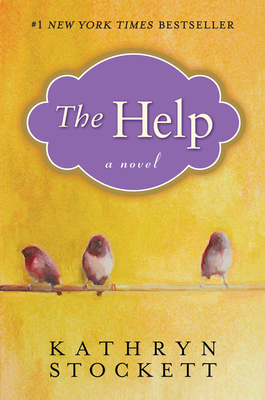
So I was curious when author Trisha R. Thomas said on her Facebook page that at first she put the book down, but picked it back up and was glad she did. I asked her to blog a review. I confess I put the book down very early on because I couldn't get past a black maid carrying on about how much she loved the white children she was raising. (And, yes, novelist jealousy might have had a little something to do with it too.)
For the record, I believe all writers have the right to tell stories about people different from them. But I believe part of the reason this book did so well was because the author was white. I have a hard time imagining the word of mouth would have been as great if the author were black. If only because if the author were black, most of y'all wouldn't have even been told about the book.
I'd be curious to hear your take. Have you read it? What did you think of it?

Below her review are some books by black authors that get mentioned in the same breath as The Help and The Secret Life of Bees (a book I liked), but so far haven't taken off the same way those books have. I'd also like those of you who read The Help to tell me what other books would you suggest?
The Help, review by Trisha R. Thomas
I was one of the many who judged a book by it’s color. What would a white woman know about the black experience, and why did she feel the need to write on the subject. The choice most likely wasn’t a choice at all. We are who we are. The old adage of write what you know feels powerfully at work here. The author, Kathryn Stockett spent the first sixteen years of her life, nearly everyday with a black woman who took care of her. That woman was her maid, Demitrie. Initially, she sought to write through Demitrie’s voice. Instead the result became “The Help”, a fictional account of Jackson, Mississippi in the 60’s. Pre-civil rights, during the unfolding of a tumultuous time for the south.
"Caring whether or not the author is black or white seems of no substance now."
Kathryn Stockett’s first novel opens with the voice of Abilene in a Southern accent so strong and improper that I know before the first sentence is complete she has something important to say. She is the lead storyteller of this taboo tale of sisterhood between the help and the white women employers in a time when the color lines were clearly marked too dangerous to cross. Soon I will hear another maid, Minny, her voice strong and spirited, raising her children with a husband who is drunk by sundown. Abilene and Minny captured my heart and ear. These were the voices that brought me back to the novel countless times when I’d given up lost in the swirl of names and activities of the Junior League of white women. Who stole who’s boyfriend? Who married who? Sharp tongued characters that blurred into one, two, three, or four at voices at time. After all, once the League ladies got together to play bridge, or plan their next big party, their topic discussion always landed on the “uncleanliness of the nigras” who by the way cooked their food, took care of their children, and waited on them hand and foot. Enough reason at any given time to throw in the towel.
And then there was Skeeter, also in the League of gentle-women. The trouble begins with Skeeter, bored and suffocating under the rigid expectations of her southern upbringing. She returns home from college without a husband and no prospects. Hair too frizzy, reed tall, and short on patience with the town’s pent up old ways, she turns her attention to having a career, unlike the other society climbing women. Luckily the local paper will give her a shot. She’ll become the new Miss Myrna, answering mail in the weekly column giving tips on housecleaning and tackling tricky issues like water stains, and silver polishing techniques. Of course she doesn’t know a thing about house cleaning. Skeeter approaches her best friend’s maid, Abilene, to give her cleaning tips. The beginning of a new relationship. Cleaning tips turn into stories. Nights are spent taking notes of Abilene’s experiences.
Everything that lies in the middle seems to disappear waiting for Abilene to speak again. To hear Abilene mourn the loss of her only son. Filling in the void with each white child she nursed and mothered. Watching the children grow into young adults with the morals she’s instilled in them more so than their own parents.
There were moments gripped with fear and anger. The truth of the times can’t be avoided. One point of the finger and a maid could go to jail, accused of stealing a piece of silver. Their lives were not their own. Held hostage at the whim of their employers.
It’s true that readers are a narcissistic bunch. We find the characters who most resemble us and our thoughts to agree with, cheer for, and feel for in their deepest pain. We celebrate their victories as our own. The Help tells an honest story of women taking a chance and stepping out of old beliefs. You can’t help but love a story when the ones you care about win in the end. Caring whether or not the author is black or white seems of no substance now. Would a black author have experienced living with a maid all her life and know the life of Skeeter, Abilene, or Minny? I don’t know about you, but my only care giver was my mother and the public school system. I’m black, an author, and could not have written The Help. We are who we are. This novel struck the nerves of both black and white readers. It especially hit mine remembering my first novel and being judged as not “black enough” What did I know about nappy? How dare I write on the subject at all? I soldiered on, ignoring the critics. I wrote what I knew to be true from my experiences. We write what we know. If we’re lucky, we do it well. Judging a book by it’s color has to end somewhere. We have to be the change we want to see in others. Open minds mean open pages. The door needs to stay unlocked for all of us. Freedom to write whatever we want. Freedom to read whatever, whomever we want.
Liked The Help? Try these
I still wish more people would read the heartwarming The Air Between Us by Deborah Johnson (reviewed here). I just recently reread it and it was even better the second time around.
While Lori Tharps' Substitute Me is about a black nanny working for a white family, it takes place in modern day New York and the black nanny in the story is middle-class and educated. (Watch for a Q&A with Lori here next week when Substitute Me pubs.)
Tuesday, June 22, 2010
Meet: Ernessa T. Carter, author of 32 CANDLES
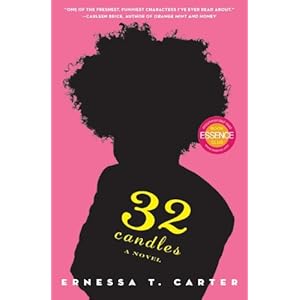
 32 Candles is one of my favorite recent reads. I loved it! And I've been so happy to get to know Ernessa's blog Fierce & Nerdy. Like the woman and the blog, the book is funny, charming and very warm.
It is my pleasure to introduce you all to someone I hope will become a very big name in readers' circles (and movie circles, the book's already been optioned) and I urge you to check out her book, which pubs TODAY!
Funnily enough, author Lori Tharps, won the Snubbr.com giveaway here and chose 32 Candles as the book she will receive. So congrats Ernessa on your pub day! And congrats Lori on winning the book!
White Readers Meet Black Authors: Tell us about your new book.
Ernessa T. Carter: It’s about Davie Jones, a girl growing up mute, poverty-stricken and unpopular in Mississippi. She sees the movie Sixteen Candles for the first time and decides that she wants her own “Molly Ringwald Ending.” Much drama ensues.
WRMBA: Describe your work for someone unfamiliar with it. What's your writing style like? What subjects/themes do you explore?
ETC: I set out to write what I would call a literary romance, and what others might call women’s fiction. The point was that I love romantic novels and I love literary novels, and I didn’t understand why they were so often mutually exclusive. I like to talk about love, dreams, sanity, and emotion in really different ways. Most of all, I like to write the books I want to read, but aren’t seeing on bookshelves. If I wasn’t a frustrated reader, I probably wouldn’t be a novelist. Also, I like original characters. If my main character reminds you of someone else’s main character, then I want to meet that novelist, because obviously she is a parallel universe me that has come here in some kind of multi-dimensional time machine, and I have a few questions for her.
WRMBA: What's your goal(s) as a writer? Do you set out to educate? entertain? illuminate?
 ETC:
ETC: I always say that if there was an apocalypse, I’d put together a troupe and travel the devastated country as a playwright and producer of quality entertainment. All I want to do is entertain and touch readers. The rest is gravy. Wait that’s not true. I also like to represent for awkward. I don’t think awkward black women have enough representation in literature.
ETC: I think a lot people do this. They say, I adore movies and I adore writing, so I should be a screenwriter. That’s what I said to myself when I went and got my MFA for Dramatic Writing. I didn’t take into account that I don’t particularly like writing with other people or being told what to do or leaving the house for work. When you take that into account, I’m probably best suited to be a novelist. I think it’s important for people to keep on reassessing their personalities and make changes accordingly. I don’t regret my tangled journey, though. I got my first FT writing job and met my husband because of my MFA, so I consider it money well-spent, an investment in my future that paid off in really strange ways.
ETC:
I recently finished up the rough draft of my second novel, THE AWESOME GIRLS GUIDE TO DATING EXTRAORDINARY MEN, which is about two years in the lives of three best friends, living, struggling, and dating in Los Angeles. I’m fixing for a heavy rewrite of that in the fall.
ETC: That’s an interesting question. Most of the authors I like have tons of fans already. For example, I’ve recommended ORANGE MINT AND HONEY to quite a few people, but usually they’ve either heard of it, already read it, or were planning to read it before I came along. Still, It took me over a year to find the graphic novel, BAYOU by Jeremy Love (which The Bottom of Heaven blogged about here), so I’d like to spread the gospel about that terrific read. I also wish more people would read BLACK WATER RISING by Attica Locke (reviewed here in the L.A. Times) and I adore how Lisa Tucker writes. Her book premises are never the same, and man, is she suspenseful.
Tuesday, May 25, 2010
Summer reads giveaway!

Summer is almost here, and it's the perfect time to catch up on a favorite book. Whether it's lying on a beach during vacation or snuggled up at home, who doesn't like to be immersed in a good book during the dog days of summer? To kick off the summer season, a giveaway! And the best part? Thanks to the kind folks at Snubbr.com, the winner gets to pick whatever book she wants!
Just leave a comment below, and tell us what book you want to read (a new release or a golden oldie) and why you want to read it. We'll pick our favorite comment after 1 week, and send the winner the book he chose, and announce it here.
What I'm looking forward to reading this summer:
A Taste of Honey by Jabari Asim. Short and sweet, connected stories. Seems perfect for sitting in an airport or lying in the hammock.

Till You Hear From Me. I have the audio book on my iPhone and plan on listening when I go to L.A. next month.
The Hundred Thousand Kingdoms by N.K. Jemisin. I read the opening chapters on the author's website and I'm hooked.
A few books I'm recommending this summer:
32 Candles by Ernessa T. Carter. I read an advance copy for a blurb. If Bridget Jones and Clareece Precious Jones had a love child, she would be Davie Jones, the protagonist in this book. Sound weird? It's not. Just very fresh and funny.
Substitute Me by Lori Tharps. I also gave a blurb for this one. It comes out in August (look for a giveaway then!). It's the story of a white couple in Brooklyn and the 30-year-old, college-educated black nanny they hire. Sexy, smart and will definitely have people talking!
Rebel Yell by Alice Randall. I just finished this one and really liked it. I expected a portrait of a marriage and I got that, but the former married couple were way more interesting than your average married folks, and the story far broader (including very timely subjects like the war in Iraq). This one is out in paperback this fall, if you want to wait.
For more ideas check out my Shelfari book shelf over to the right. Also check Snubbr.com. They're a recommendation site. What you do is ask a question such as "What books do you recommend for someone who likes mysteries?" and they'll send a question to an expert who will answer it for you. It's sorta like Yahoo Answers, but instead of random people answering your question, only experts are allowed to answer them.
So what do you want to read this summer?
Tuesday, June 23, 2009
Late June Links

Attica Locke's new novel Black Water Rising was well-reviewed in the NY Times.
The Times also interviews Michael Thomas about winning the International Impac Dublin Literary Award for his novel Man Gone Down (Thomas worries about becoming a "poster boy for uplift.")
Penguin launched a site to bring more attention to their books that miss out on mainstream media attention. Nordette Adams marvels that Penguin's black authors must be getting lots of media play as they weren't included on Penguin's new site.
Author Lori Tharps is running an interview with me and giving away a copy of Children of the Waters, my new novel out today!
On The Root's Book Blog Felicia Pride wonders if people are going to pick up books written by President Obama's relatives (and discusses a few other cool topics, like Victor LaValle's new novel The Big Machine and the nominees for the 2009 Hurston/Wright Legacy Awards.)
Bernice McFadden wishes Oprah would read more black authors.
Worucopia reminded me June is Gay Pride Month. James Baldwin, a black gay writer once said, "The price one pays for pursuing any profession, or calling, is an intimate knowledge of its ugly side." All too true.
Subscribe to:
Posts (Atom)